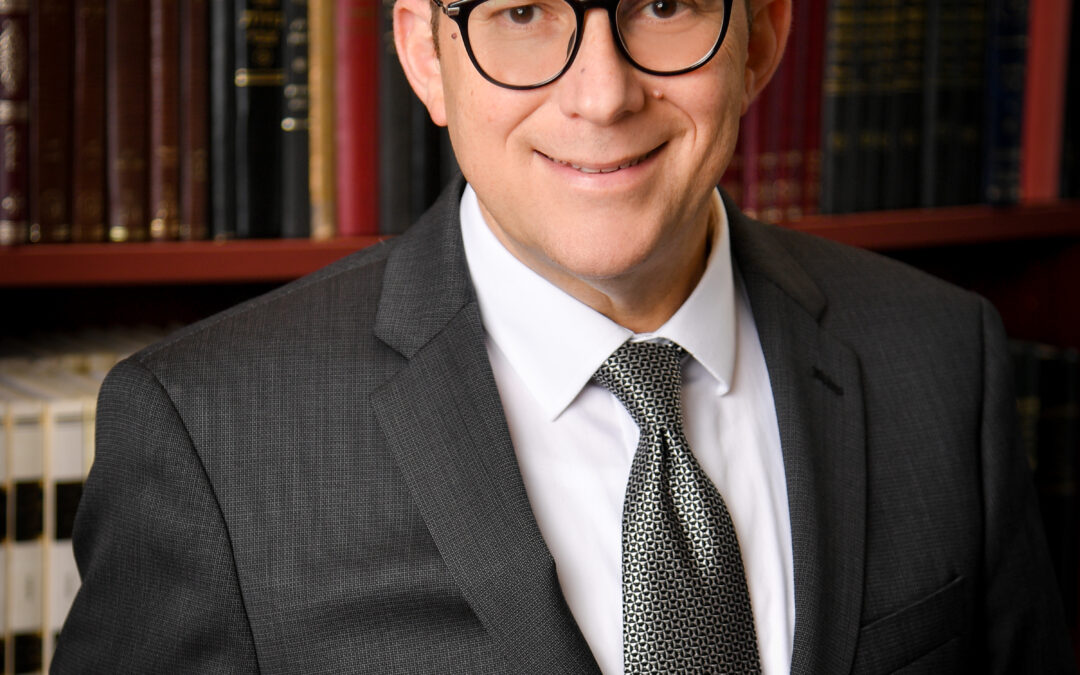
Rabbi Eric Grossman, Head of School
Does My Teacher Notice Me? by Tyler Gilbert, is a new book on pedagogical practice released this year. I know that I constantly asked myself this question when I was in school, and I assume that it is likewise top of mind for students today. I find it surprising that it has taken until 2025 for a book on this subject to be published.
Students engage in all manner of behaviours in the hope of being noticed. In class they put up their hands to answer or ask questions not only because they know or want to know the answer, but also just to be acknowledged by the adult in the room. Students seek recognition by working to win academic awards or striving to be at the top of the class. Students also engage in less productive attention-getting activities such as acting out, being the class clown or, in extreme cases, engaging in self-destructive actions like purposefully failing classes or worse.
Schools are microcosms of society and, as such, mirror a larger human need to be noticed. In our families, at our jobs, among our friends, and in our communities, we manifest a deep psychological desire to be recognized. We ask ourselves: Do Others Notice Me?
This need to be noticed derives from a fundamental fear we harbour that there is nothing about us that stands out or makes us worthy of recognition. This is expressed in the words of the Machzor:
What are we? What is our life?
What are our acts of kindness?
What is our righteousness?
What is our deliverance?
What is our strength? What is our power?
What can we say before You,
Lord, our God and God of our fathers?
Are not all the mighty
as nothing before You?
Famous people as though they had never been?
The wise as if they were without knowledge?
And men of understanding
as if they were devoid of intelligence?
For most of their actions are a waste
and the days of their life
are trivial in Your presence.
The superiority of man over the beast
is nothing, for all is futile.
The message of this prayerful meditation is that humans are mortal and insignificant; there is nothing about us that makes us stand out. Like all living creatures, we are born, die, and are not remembered. Even the greatest of all men and women, those who are top-of-class, are no different.
The words quoted above appear several times in the High Holiday liturgy, a repeated reminder of our mortality during these Days of Awe. But as the Yamim Nora’im draw to a close, at the end of the Neilah service, there is an extra line added to the prayer:
But You [God] have set humans apart from the beginning,
And recognized them to stand before You.
Despite our cosmic insignificance, God notices us. Since the beginning of the world, God has recognized that there is something special about humanity that sets us apart from other creatures. God notices each of us, which is why our deeds—good and bad—matter to Him. There would be no need for the Days of Repentance if we and our actions were meaningless. It is only because we matter that we are called upon to stand before God to ask for forgiveness.
Returning to Gilbert’s book, the author outlines three phases of Teacher Noticing: Observing (taking in information), Interpreting (making sense of what we observe), and Deciding (determining the reaction). He illustrates his three-part paradigm by describing two teachers observing the same student behaviour:
First Teacher:
-Teacher observes student working well then suddenly putting her head on her desk.
-Teacher interprets this action, inferring the student is being lazy.
-Teacher decides to ignore the student and focus instead on the other children who are actually doing their work.
Second Teacher
-Teacher observes student working well then suddenly putting her head on her desk.
-Teacher interprets this action, inferring student is struggling.
-Teacher decides to approach the student and say, “I see you’ve run into some trouble, let me help you get back to the better place you were before.”
Gilbert suggests that when students call out for attention, teachers must do more than just notice them: Teachers must interpret students’ actions with empathy and decide to help them get back to a better place.
At Akiva School, we are dedicated to the individuality of every student and approach each with the empathy that Gilbert describes. This has always been the Akiva Way: the educational philosophy Gilbert writes about in 2025 was set down by Akiva’s founder Rabbi David Hartman in 1968.
Like students seeking our teacher’s attention, we yearn to be noticed by God. And, like students, beyond recognition, we also desire God’s empathy. We want Him to assume that we have done wrong not out of laziness or obstinance, but because we have run into trouble. And even when our sins have been our own fault, we want God, like the second teacher, to give the most charitable interpretation of our actions.
Finally, we want God to decide in our favour and help us get back to a better place. This is the meaning of teshuvah, a return to our best selves.
We fear that, like the first teacher, God will ignore us and dismiss us in favour of those who have better lived up to His expectations. But our hope and our faith is that God will act as the second teacher, interpreting our actions with empathy and deciding in our favour. In return, we promise God to do likewise to those around us—students, children, family and friends—interpret their actions favourably, and ensure they never question whether we notice them.
The shofar that we blow throughout the High Holiday season embodies our cry for attention. May God hear its sound and the call of our prayers, may He take notice of each of us, and may He bring us, and the Jewish people, back to a better place.
Just as we notice and care for our students, we pray that God notice us, decide in our favour, and bless us with a year of goodness and success.
Karynne, Ezra, and Max join me in wishing the Akiva community a shanah tovah.
Rabbi Eric Grossman